

Klant login
Log in
Registreer
Het aanmaken van een account heeft vele voordelen:
- Bekijk bestelling en verzendstatus
- Bekijk bestelgeschiedenis
- Reken sneller af
Winkelwagen
Subtotaal winkelwagen
x
Bedrag:
Gratis
U heeft geen product(en) in uw winkelwagen.
Talen
Google Translate:
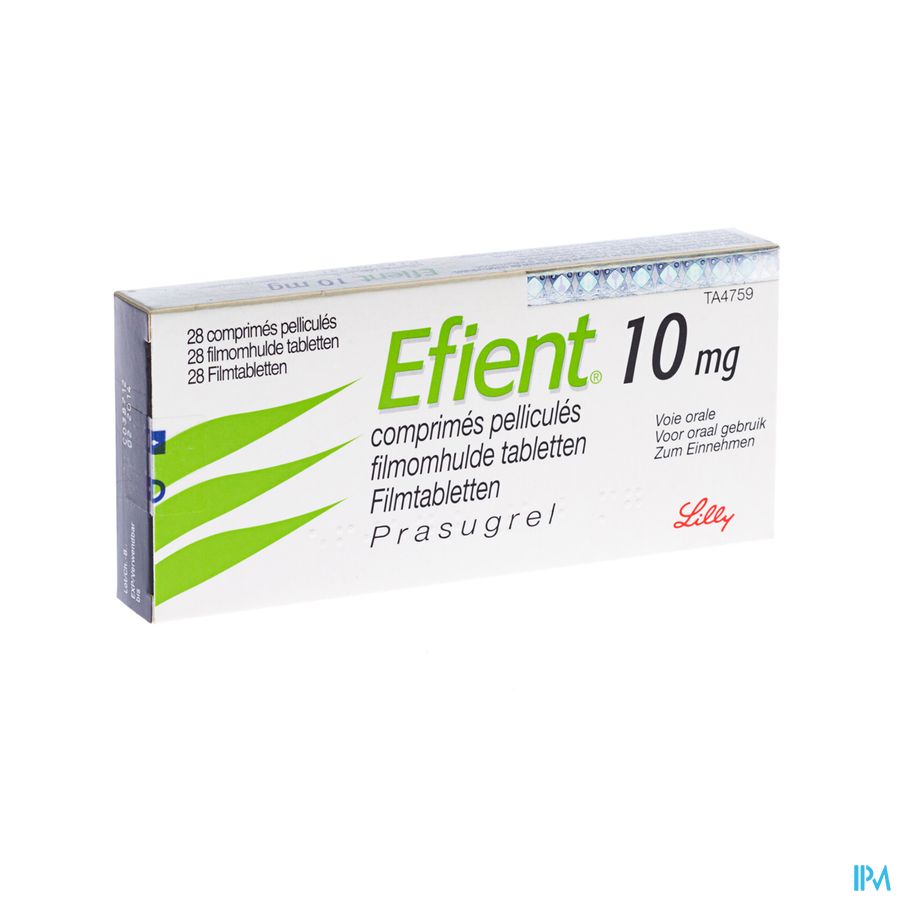
Efient Comp Pell 28 X 10mg
Terugbetaalbaar
Als je recht hebt op een terugbetaling voor dit geneesmiddel, betaal je in de apotheek een verlaagde prijs en niet de prijs die op onze webshop vermeld staat.
Prijs met gewone tegemoetkoming
U betaalt: € 7,44 (6% inclusief btw)
Prijs met verhoogde tegemoetkoming
U betaalt: € 4,42 (6% inclusief btw)
Belangrijke informatie
Voor dit geneesmiddel is een voorschrift nodig. Na beoordeling door de apotheker kan je het komen afhalen en betalen.
Niet beschikbaar
Neem contact op met ons via telefoon of e-mail, dan bekijken we samen de mogelijkheden.
4.4 Special warnings and precautions for use Bleeding risk In the phase 3 clinical trial (TRITON) key exclusion criteria included an increased risk of bleeding; anaemia; thrombocytopaenia; a history of pathological intracranial findings. Patients with acute coronary syndromes undergoing PCI treated with Efient and ASA showed an increased risk of major and minor bleeding according to the TIMI classification system. Therefore, the use of Efient in patients at increased risk of bleeding should only be considered when the benefits in terms of prevention of ischaemic events are deemed to outweigh the risk of serious bleedings. This concern applies especially to patients: • ≥ 75 years of age (see below). • with a propensity to bleed (e.g. due to recent trauma, recent surgery, recent or recurrent gastrointestinal bleeding, or active peptic ulcer disease) • with body weight < 60 kg (see sections 4.2 and 4.8). In these patients the 10 mg maintenance dose is not recommended. A 5 mg maintenance dose should be used. • with concomitant administration of medicinal products that may increase the risk of bleeding, including oral anticoagulants, clopidogrel, non-steroidal anti-inflammatory drugs (NSAIDs), and fibrinolytics. For patients with active bleeding for whom reversal of the pharmacological effects of Efient is required, platelet transfusion may be appropriate. The use of Efient in patients ≥ 75 years of age is generally not recommended and should only be undertaken with caution after a careful individual benefit/risk evaluation by the prescribing physician indicates that benefits in terms of prevention of ischaemic events outweigh the risk of serious bleedings. In the phase 3 clinical trial these patients were at greater risk of bleeding, including fatal bleeding, compared to patients < 75 years of age. If prescribed, a lower maintenance dose of 5 mg should be used; the 10 mg maintenance dose is not recommended (see sections 4.2 and 4.8). Therapeutic experience with prasugrel is limited in patients with renal impairment (including ESRD) and in patients with moderate hepatic impairment. These patients may have an increased bleeding risk. Therefore, prasugrel should be used with caution in these patients. Patients should be told that it might take longer than usual to stop bleeding when they take prasugrel (in combination with ASA), and that they should report any unusual bleeding (site or duration) to their physician. Bleeding Risk Associated with Timing of Loading Dose in NSTEMI In a clinical trial of NSTEMI patients (the ACCOAST study), where patients were scheduled to undergo coronary angiography within 2 to 48 hours after randomization, a prasugrel loading dose given on average 4 hours prior to coronary angiography increased the risk of major and minor peri-procedural bleeding compared with a prasugrel loading dose at the time of PCI. Therefore, in UA/NSTEMI patients, where coronary angiography is performed within 48 hours after admission, the loading dose should be given at the time of PCI (see sections 4.2, 4.8 and 5.1). Surgery Patients should be advised to inform physicians and dentists that they are taking prasugrel before any surgery is scheduled and before any new medicinal product is taken. If a patient is to undergo elective surgery, and an antiplatelet effect is not desired, Efient should be discontinued at least 7 days prior to surgery. Increased frequency (3-fold) and severity of bleeding may occur in patients undergoing CABG surgery within 7 days of discontinuation of prasugrel (see section 4.8). The benefits and risks of prasugrel should be carefully considered in patients in whom the coronary anatomy has not been defined and urgent CABG is a possibility. Hypersensitivity including angioedema Hypersensitivity reactions including angioedema have been reported in patients receiving prasugrel, including in patients with a history of hypersensitivity reaction to clopidogrel. Monitoring for signs of hypersensitivity in patients with a known allergy to thienopyridines is advised (see section 4.8). Thrombotic Thrombocytopaenic Purpura (TTP) TTP has been reported with the use of prasugrel. TTP is a serious condition and requires prompt treatment. Lactose and sodium Patients with rare hereditary problems of galactose intolerance, total lactase deficiency or glucose�galactose malabsorption should not take this medicine. This medicine contains less than 1 mmol sodium (23 mg) per tablet, that is to say essentially 'sodium�free'. Morphine and other opioids Reduced prasugrel efficacy has been seen in patients co-administered prasugrel and morphine (see section 4.5).
- bij patiënten met acuut coronair syndroom (instabiele angina pectoris, myocardinfarct met of zonder ST-elevatie) die primaire of uitgestelde percutane coronaire interventie ondergaan
- gelijktijdig toegediend met acetylsalicylzuur
- KWALITATIEVE EN KWANTITATIEVE SAMENSTELLING
Efient 10 mg:
Elke tablet bevat 10 mg prasugrel (als hydrochloride).
Hulpstof(fen) met bekend effect
Elke tablet bevat 2,1 mg lactosemonohydraat.
Efient 5 mg:
Elke tablet bevat 5 mg prasugrel (als hydrochloride).
Hulpstof(fen) met bekend effect
Elke tablet bevat 2,7 mg lactosemonohydraat.
Voor de volledige lijst van hulpstoffen, zie rubriek 6.1.
Morfine en andere opioïden
Een verminderde werkzaamheid van prasugrel is waargenomen bij patiënten die gelijktijdig prasugrel en morfine toegediend krijgen (zie rubriek 4.5).
4.5 Interacties met andere geneesmiddelen en andere vormen van interactie
Warfarine: gelijktijdige toediening van Efient en andere cumarinederivaten dan warfarine is niet onderzocht. Vanwege de kans op een verhoogd bloedingsrisico is voorzichtigheid geboden wanneer warfarine (of andere cumarinederivaten) en prasugrel gelijktijdig worden toegediend (zie rubriek 4.4).
Niet-steroïde anti-inflammatoire middelen (NSAID's): gelijktijdige toediening met chronisch gebruikte NSAID's is niet onderzocht. Vanwege de kans op een verhoogd bloedingsrisico is voorzichtigheid geboden wanneer chronisch gebruikte NSAID's (waaronder COX-2-remmers) en Efient gelijktijdig worden toegediend (zie rubriek 4.4).
Efient kan wel gelijktijdig worden toegediend met geneesmiddelen die door cytochroom P450-enzymen (waaronder statinen) worden gemetaboliseerd, of met geneesmiddelen die inductoren of remmers van cytochroom P450-enzymen zijn. Ook kan Efient gelijktijdig worden toegediend met ASA, heparine, digoxine en geneesmiddelen die de pH in de maag verhogen, zoals protonpompremmers en H2-blokkers. Hoewel dit niet in specifieke interactiestudies is onderzocht, is Efient in het klinische fase 3-onderzoek gelijktijdig toegediend met laagmoleculairgewichtheparine, bivalirudine en GP IIb/IIIa-remmers (geen informatie beschikbaar over het gebruikte type GP IIb/IIIa-remmer) zonder aanwijzingen voor klinisch significante ongewenste interacties.
4.8 Possible side effects Like all medicines, this medicine can cause side effects, although not everybody gets them. Contact your doctor immediately if you notice any of the following: • Sudden numbness or weakness of the arm, leg or face, especially if only on one side of the body. • Sudden confusion, difficulty speaking or understanding others. • Sudden difficulty in walking or loss of balance or co-ordination. • Sudden dizziness or sudden severe headache with no known cause. All of the above may be signs of a stroke. Stroke is an uncommon side effect of Efient in patients who have never had a stroke or transient ischaemic attack (TIA).
Also contact your doctor immediately if you notice any of the following: • Fever and bruising under the skin that may appear as red pinpoint dots, with or without unexplained extreme tiredness, confusion, yellowing of the skin or eyes (jaundice) (see section 2 'What you need to know before you take Efient'). • A rash, itching, or a swollen face, swollen lips/tongue, or shortness of breath. These may be signs of a severe allergic reaction (see section 2 'What you need to know before you take Efient'). Tell your doctor promptly if you notice any of the following: • Blood in your urine. • Bleeding from your rectum, blood in your stools or black stools. • Uncontrollable bleeding, for example from a cut. All of the above may be signs of bleeding, the most common side effect with Efient. Although uncommon, severe bleeding can be life-threatening. Common side effects (may affect up to 1 in 10 people) • Bleeding in the stomach or bowels • Bleeding from a needle puncture site • Nose bleeds • Skin rash • Small red bruises on the skin (ecchymoses) • Blood in urine • Haematoma (bleeding under the skin at the site of an injection, or into a muscle, causing swelling) • Low haemoglobin or red blood cell count (anaemia) • Bruising Uncommon side effects (may affect up to 1 in 100 people) • Allergic reaction (rash, itching, swollen lips/tongue, or shortness of breath) • Spontaneous bleeding from the eye, rectum, gums or in the abdomen around the internal organs • Bleeding after surgery • Coughing up blood • Blood in stools Rare side effects (may affect up to 1 in 1,000 people) • Low blood platelet count • Subcutaneous haematoma (bleeding under the skin causing a swelling) Reporting of side effects If you get any side effects, talk to your doctor or pharmacist. This includes any possible side effects not listed in this leaflet. You can also report side effects directly via the national reporting system listed in Appendix V. By reporting side effects you can help provide more information on the safety of this medicine.
Overgevoeligheid voor de werkzame stof of voor één van de in "Samenstelling" vermelde hulpstoffen.
Actieve pathologische bloedingen.
Voorgeschiedenis van cerebrovasculair accident (CVA) of transient ischaemic attack (TIA).
Ernstige leverfunctiestoornis (Child Pughklasse C).
4.6 Fertility, pregnancy and lactation No clinical study has been conducted in pregnant or breast-feeding women. Pregnancy Animal studies do not indicate direct harmful effects with respect to pregnancy, embryonal/foetal development, parturition or postnatal development (see section 5.3). Because animal reproduction studies are not always predictive of a human response, Efient should be used during pregnancy only if the potential benefit to the mother justifies the potential risk to the foetus. Breast-feeding It is unknown whether prasugrel is excreted in human breast milk. Animal studies have shown excretion of prasugrel in breast milk. The use of prasugrel during breastfeeding is not recommended. Fertility Prasugrel had no effect on fertility of male and female rats at oral doses up to an exposure 240 times the recommended daily human maintenance dose (based on mg/m2 ).
Volwassenen
- Eenmalige oplaaddosis: 60 mg
- Onderhoudsdosis: 10 mg per dag
- Ook 75 mg tot 325 mg acetylsalicylzuur toevoegen
Toedieningswijze
- Met of zonder voedsel.
- De werking kan het snelst intreden als de oplaaddosis van 60 mg prasugrel op de nuchtere maag wordt ingenomen
- De tablet niet breken of fijnmaken.
| CNK | 2630861 |
|---|---|
| Organisaties | De Eurocept Groep, SAS Substipharm |
| Merken | Daiichi Sankyo |
| Breedte | 65 mm |
| Lengte | 142 mm |
| Diepte | 22 mm |
| Hoeveelheid verpakking | 28 |
| Actieve ingrediënten | prasugrel hydrochloride |
| Behoud | Kamertemperatuur (15°C - 25°C) |


